
Estimated reading time: 7 minutes
For many convenience stores and gas stations, tobacco products remain one of the largest traffic drivers in the business. While fuel gets customers onto the property, tobacco purchases often lead to additional sales like beverages, snacks, lottery tickets, and other impulse items. According to NACS, inside sales generate the majority of gross profit for convenience retailers, making every tobacco customer valuable to the overall business.
That value also comes with responsibility.
One sale to an underage customer can trigger a series of problems that extend well beyond a simple fine. Store owners sometimes believe one mistake is no big deal, but regulators do not always see it that way. The FDA actively conducts compliance inspections across the country, and repeated violations can place your business on a public list that customers, suppliers, competitors, and even future buyers can search.
Nobody wants their business known for the wrong reason.
Understanding FDA Compliance Inspections
One of the biggest surprises for new store owners is how FDA inspections actually happen.
Inspectors usually don’t announce themselves. Instead, trained inspectors work with underage buyers during compliance checks to determine whether retailers follow federal tobacco sales regulations. Employees generally don’t know they are participating in an inspection until after the transaction has already taken place.
That means every tobacco sale should be handled exactly the same way whether it’s a regular customer or someone you’ve never seen before because there really isn’t a second chance once the transaction is completed and trying to explain afterward rarely changes the outcome.
Consistency matters more than luck.
What Is the FDA Violator List?
The FDA maintains a public Tobacco Compliance Check Outcomes database that records inspection results for tobacco retailers nationwide.
Depending on the inspection results, retailers may receive:
- Warning Letters
- Civil Money Penalties
- No-Tobacco-Sale Orders
- Records showing no violations during an inspection
Since the database is publicly searchable, your compliance history becomes part of your business reputation. A distributor researching potential partners or an investor evaluating a location can easily review previous enforcement actions.
That isn’t something most owners think about during a busy Friday afternoon.
The Cost Goes Beyond a Fine
The financial impact of an underage tobacco sale is often much larger than the initial penalty.
Repeated violations may result in temporary restrictions on selling tobacco products altogether. For many stores, losing tobacco sales doesn’t just reduce cigarette revenue. Customers purchasing tobacco frequently buy drinks, candy, coffee, and fuel during the same visit. Remove tobacco from the equation and basket size often shrinks as well.
Retail shrink is already creating enough pressure on store profitability. According to the National Retail Federation, retailers lost an estimated $112.1 billion to shrink in 2022, driven by theft, operational errors, fraud, and other preventable losses. Adding compliance penalties only makes protecting profits more difficult.
Build Better Compliance Habits
Technology is valuable, but it works best alongside strong operating procedures.
A few practical habits make a noticeable difference:
- Require ID verification whenever store policy or state law requires it.
- Review tobacco transactions with employees during routine coaching sessions.
- Audit unusual cashier activity instead of waiting for a problem to surface.
- Document employee training on age-restricted sales.
Training shouldn’t happen only after someone makes a mistake.
Actually, speaking of routines, it’s funny how coffee always seems to disappear twice as fast during inventory day. Nobody really knows why, it just does.
Anyway, back to compliance.
Regular reviews create accountability without making employees feel like they’re constantly being watched.
Connect Compliance With Video Evidence
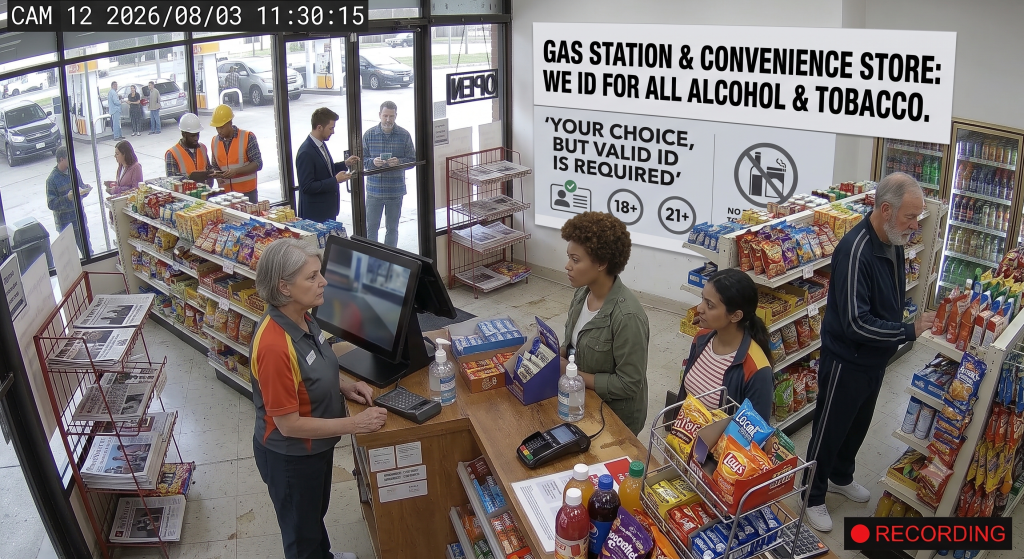
Many stores already have surveillance cameras installed.
Unfortunately, most systems simply record video and store it until someone remembers to look for something. Searching through hours of footage after an incident wastes valuable management time.
Petrosoft Loss Prevention Analytics (LPA) approaches surveillance differently.
Instead of relying only on recorded video, LPA connects POS transaction data directly with surveillance footage. When an age-restricted sale occurs, managers can quickly locate the associated transaction and review the corresponding video to verify whether proper ID procedures were followed.
Rather than searching through an entire shift, attention goes directly to transactions that deserve review.
Retailers searching for retail loss prevention software, customer ID verification, and loss prevention systems are increasingly adopting integrated technology because it strengthens accountability while improving operational visibility. These keyword areas continue to be important within Petrosofts digital marketing strategy for Loss Prevention Analytics.
Build a Smarter Tobacco Compliance Process With Petrosoft
Preventing underage tobacco sales isn’t about relying on one employee to remember every policy during a busy shift. It’s about creating a system where technology reinforces good habits and gives managers the visibility needed to coach employees before a violation occurs.
Petrosoft’s integrated platform brings together SmartPOS®, C-Store Office® (CSO), and Loss Prevention Analytics (LPA) to create multiple layers of protection throughout the entire transaction.
At the register, SmartPOS® supports age-restricted sales by prompting cashiers during tobacco, nicotine, alcohol, and other restricted purchases. Instead of depending entirely on memory, the system reinforces store procedures at the exact moment they matter. During a busy rush it’s easy for someone to become distracted, and honestly every cashier has experienced three customers asking questions at once while another customer is waiting for cigarettes so those reminders become pretty important.
Every age-restricted transaction is then recorded within C-Store Office®, giving owners and managers detailed reporting on tobacco sales, cashier activity, exceptions, and store performance. Rather than guessing whether procedures are being followed, management can review transaction history, identify trends, and recognize employees who may benefit from additional coaching. Regular reporting also creates documentation that supports ongoing compliance efforts across every shift.
When additional review is needed, Petrosoft Loss Prevention Analytics (LPA) connects SmartPOS transaction data directly to surveillance video. If a questionable tobacco sale occurs, managers can immediately locate the exact transaction and watch the associated video instead of searching through hours of camera footage. That saves valuable time while providing clear documentation of whether proper ID verification procedures were followed.
Together, these three solutions create a continuous compliance workflow:
- SmartPOS reinforces proper age verification during the sale.
- C-Store Office records and reports every transaction for management review.
- Loss Prevention Analytics links the transaction with video evidence for faster investigations and employee coaching.
This approach turns every tobacco transaction into a learning opportunity instead of waiting until an FDA inspector finds a problem first.
Train Employees Before Mistakes Become Violations
One of the biggest advantages of connecting SmartPOS, C-Store Office, and LPA is the ability to coach employees using actual transactions from your own store.
Instead of reminding staff to “be more careful,” managers can review specific age-restricted sales, discuss what happened, reinforce company policies, and recognize employees who consistently follow procedures correctly. Training becomes more relevant because it is based on real situations rather than generic examples.
Over time, this creates stronger consistency across every shift. Employees gain confidence, managers spend less time investigating incidents, and store owners reduce the risk of costly FDA violations while protecting one of their most profitable product categories.
Create a Compliance Culture
The most successful operators don’t depend on chance.
They create systems that encourage consistent behavior every shift.
Employees perform better when expectations are clear, managers regularly review transactions, and technology supports store policies. Most cashiers genuinely want to follow the rules, but busy stores create distractions. Long lines, multiple register requests, fuel questions, lottery transactions, and tobacco sales can all happen within a few minutes.
That’s exactly why standardized procedures matter.
Protect Your Reputation Along With Your Revenue
Avoiding the FDA Violator List isn’t simply about avoiding penalties.
It’s about protecting your reputation, preserving customer confidence, maintaining supplier relationships, and reducing unnecessary business risk.
A modern convenience store needs more than security cameras and written policies. Connecting transaction data with surveillance creates a stronger compliance process, improves employee accountability, and gives managers faster access to information when questions arise.
Every tobacco transaction represents more than a sale.
It’s an opportunity to demonstrate that your business takes compliance seriously while protecting one of its most valuable product categories.
Frequently Asked Questions
How does a store end up on the FDA Violator List?
Stores appear in the FDA Tobacco Compliance Check Outcomes database after FDA compliance inspections identify violations or document enforcement actions related to tobacco sales.
Does every violation result in losing tobacco sales?
No. Initial violations often begin with a Warning Letter, while repeated violations may lead to Civil Money Penalties and eventually a No-Tobacco-Sale Order depending on the enforcement history.
Can the public search my stores compliance history?
Yes. The FDA maintains a searchable public database containing inspection outcomes for tobacco retailers across the United States.
How often should tobacco compliance training occur?
Training should be part of new employee onboarding and reinforced regularly throughout the year, especially after policy updates or operational changes.
How does Petrosoft Loss Prevention Analytics improve compliance?
Petrosoft LPA connects POS transaction data with surveillance video, allowing managers to review age-restricted transactions quickly, verify ID procedures, identify coaching opportunities, and strengthen compliance across one or multiple store locations.
Will integrated surveillance replace employee training?
No. Technology supports accountability and documentation, while consistent employee education remains the foundation of a successful tobacco compliance program.