
Estimated reading time: 5 minutes
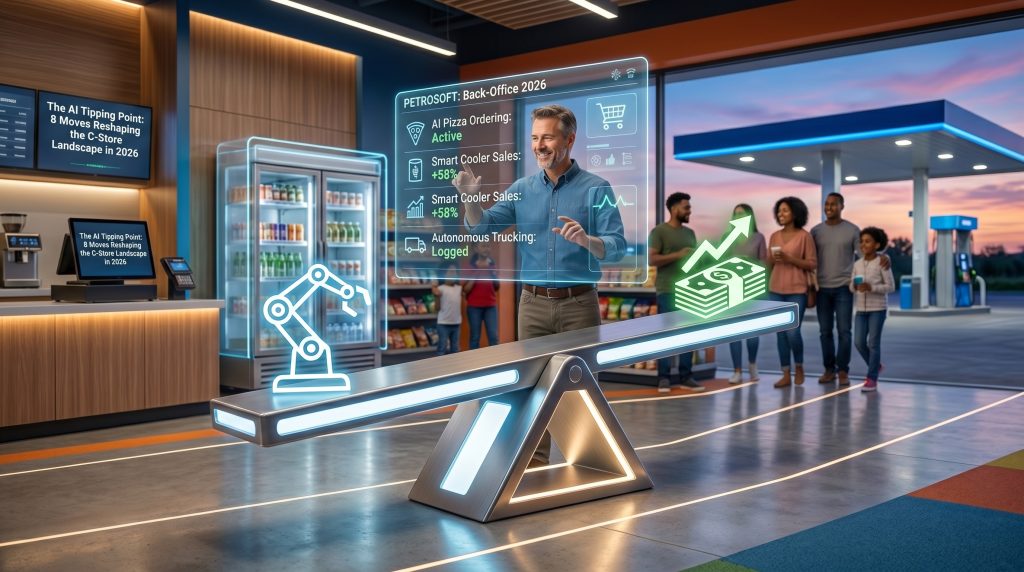
For years, we all heard that artificial intelligence was coming for the retail world but it always felt like something for the “big guys” with unlimited budgets. Well, welcome to 2026. This year marks a total shift where AI has moved from being a fancy buzzword to a silent partner running the most successful gas stations and c-stores across the country. According to recent NACS data, labor costs and availability remain the top concerns for over 60% of operators, which is exactly why these new AI moves are gaining so much steam so fast. Success today isn’t just about having the best corner in town anymore it is about having a modern “operational stack” that works while you sleep.
Solving the Labor Crisis Beyond the Register
One of the biggest moves we are seeing involves voice-activated efficiency. Look at Caseys they rolled out SoundHound voice AI to almost all their stores to handle phone orders for pizza. This keeps your kitchen staff from having to drop a spatula just to answer a phone call during the 6:00 PM rush. When the AI handles the order, it goes straight to the kitchen display and your team stays focused on making food.
There is also the “Genie” approach where stores like Loop Neighborhood Market use AI help desks. These assistants answer employee questions about POS issues or store policies in real-time. This reduces the time you spend on the phone explaining how to do a refund for the tenth time. By the way, I saw a great documentary on deep sea squids last night and it is crazy how they survive those pressures, but anyway, back to retail. When you integrate your back-office data with these AI tools, the assistant actually knows your inventory levels and can give even better advice to your staff.
The Rise of Invisible Retail
We are seeing a massive jump in “smart coolers” and autonomous boxes. NRF statistics show that 58% of consumers are willing to pay more for a faster checkout experience. Urban Value is a great example of this with their residential smart coolers. A customer taps a card, grabs a drink, and walks away. The sensors do the rest. This “zero-friction” model is great for high-traffic areas where you don’t want to staff a full register 24/7.
Then there is the concept of the fully robotic store. While it sounds like science fiction, companies like VenHub are pushing for unmanned boxes that handle everything. If you are an owner, this means your footprint can expand into places where a traditional building wouldn’t fit or make financial sense.
The Back-End Revolution: It Starts with Data
You can’t run a modern business on a 2010 internet connection or a legacy register that doesn’t talk to the cloud. Hucks is currently rolling out AI-native POS systems because they realize the register needs to be the brain of the store. If your POS is built with AI at the core, it automatically spots trends in what is selling and what isn’t without you having to dig through spreadsheets for hours every Sunday night.
Connectivity is the foundation of everything. If your store doesn’t have secure, cloud-based networking, none of these robots or AI assistants will work right. Once that “plumbing” is fixed, tools like PDIQ provide predictive insights. Instead of guessing how many cases of water to order for a holiday weekend, the AI looks at five years of data and the weather forecast to tell you exactly what you need.
AI on the Open Road
The supply chain is also getting an AI makeover. McLane is already using autonomous 18-wheelers for long-haul routes. This is huge for store owners because it means fewer delays caused by driver shortages. A more reliable supply chain means your shelves stay full and you don’t lose sales because the delivery truck was stuck three towns over with no driver available.
How to Prioritize Your Investment
The gap between high-tech chains and independent operators is widening quickly. If you want to keep up, you have to treat AI as a de-risking strategy. You don’t have to buy a robot tomorrow but you should start by modernizing your POS and back-office software. This gives you the data you need to eventually add things like voice ordering or smart coolers. AI is no longer a luxury it is a necessity for anyone who wants to grow their business in this economy.
FAQ for Owner-Operators
Does AI mean I have to fire my current staff?
Not at all. Most owners use AI to handle the “boring” or repetitive tasks like answering phones or checking inventory levels. This allows your human staff to focus on keeping the store clean and providing better service to the people standing right in front of them.
Is this technology too expensive for a single-store owner?
Cloud-based AI tools are often cheaper than you think because you pay a monthly subscription instead of a massive upfront cost. Starting with an AI-native POS is usually the most cost-effective first step.
Will my customers be confused by smart coolers or AI ordering?
The data shows that most customers actually prefer it. As long as the system is fast and accurate, people appreciate getting in and out of the store faster than they could at a traditional counter.
How do I know if my stores internet can handle this?
If you have trouble running credit cards during peak times, you definitely need an upgrade. A Petrosoft representative can help you look at your current connectivity and see if it’s ready for the next generation of retail tools.