
Estimated reading time: 4 minutes
Owning one or two convenience stores is an exercise in presence. You know which cashier works the morning shift, you see deliveries come through the back door, and you can spot inventory shrinkage just by walking the aisles.
Then comes store number three. And four. Suddenly, the operational model that brought initial success starts cracking at the seams.
Moving from 2 to 10 locations is widely considered the most dangerous phase of c-store and retail fuel growth. It is the exact threshold where hands-on management must transform into systematic operational control. The single most decisive factor that separates retailers who reach 10 profitable stores from those who burn out isn’t deeper pockets, cheaper fuel contracts, or better real estate.
The #1 driver of multi-store scale is partnering with a back-office provider that acts as a business mentor – one built by actual store operators who guide your operational process every step of the way.
The “Owners Presence” Illusion
When operating two stores, paper invoices, basic spreadsheets, and gut instinct can keep the business afloat. You can personally verify delivery counts and audit registers at night.
At five or ten locations, physical presence is no longer possible:
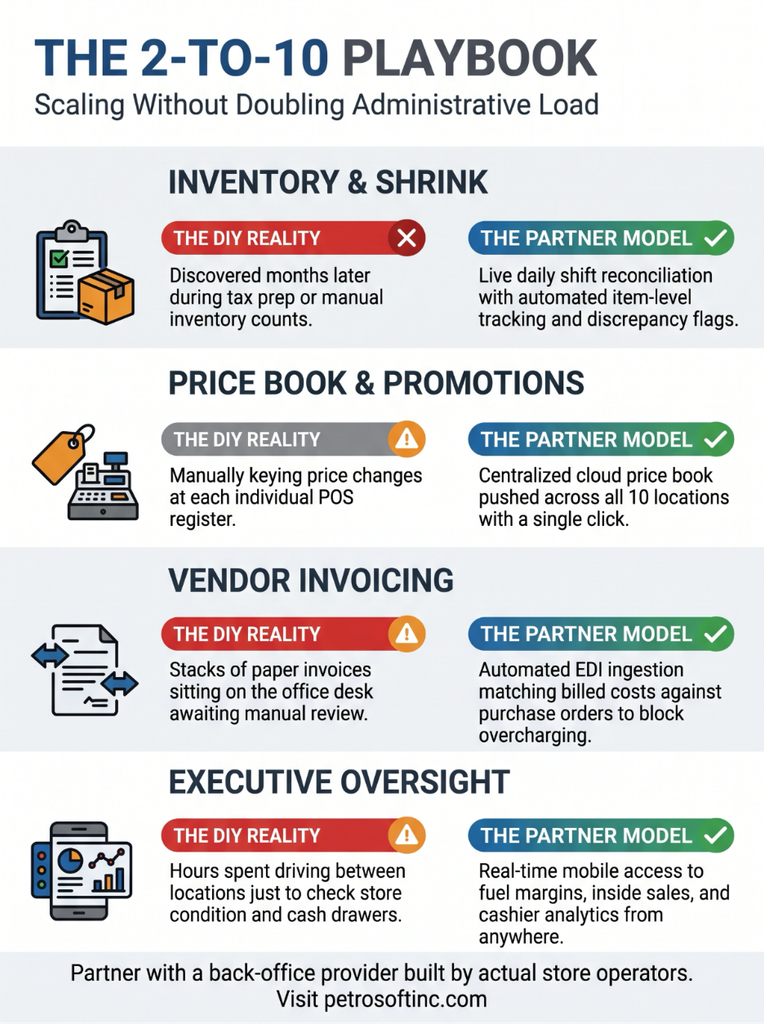
- Margin leakage compounds silently: A 1.5% margin discrepancy across two stores hurts; across seven or eight, it wipes out net profitability.
- Price book fragmentation takes over: Running localized promotions or updating wholesale price hikes across individual POS terminals becomes a full-time nightmare.
- Shrink turns into an unmonitored line item: Without automated item-level tracking, missing cartons, unaccounted waste, and delivery shortages go unnoticed until quarterly accounting reconciliation.
Many operators recognize these warning signs and buy software. Yet software purchases alone routinely fail to solve the core problem.
Why Generic Software Fails Growing Retailers
The c-store technology market is crowded with platforms designed in tech incubators by developers who have never worked a night shift, audited a vendor invoice, or faced a DSD (Direct Store Delivery) driver pushing an unexpected price increase.
Retailers often invest thousands into an enterprise tool, only to encounter:
- Endless feature bloat: A dashboard packed with 200 reports, none of which directly point to daily inventory leaks.
- “Submit a ticket” onboarding: Video libraries and generic PDF manuals that leave staff to figure out price-book architecture independently.
- Software abandonment: After 90 days of frustration, operators fall right back into manual spreadsheets because the software didn’t fit their actual floor operations.
Software does not scale multi-store operations; standardized operational discipline scales multi-store operations. Without hands-on implementation guidance, back-office software remains an expensive digital ledger.
What a Real Retail Growth Partnership Delivers
Scaling from 2 to 10 locations requires a back-office provider that operates as an operational co-pilot:
Step-by-Step Operational Onboarding
A true growth partner doesn’t simply deliver login credentials. They structure onboarding around daily, weekly, and monthly retail cadences:
- Day-to-day register closing: Teaching managers how to catch register discrepancies within minutes of shift handover.
- Automated Electronic Data Interchange (EDI): Establishing automated vendor invoice processing so wholesale cost changes reflect instantly on retail shelves without manual data entry.
- Item-level inventory cycles: Establishing rolling physical count schedules rather than disruptive quarterly inventory shut-downs.
Guidance Rooted in Operator DNA
There is an unmistakable difference between a software vendor and an operator-founded technology partner.
Petrosoft was not engineered in a vacuum; it was built out of necessity by an operator managing 18 locations spread hundreds of miles across multiple states. Every workflow, sync mechanism, and inventory report was born directly from real-world fuel and c-store operations – designed to solve the exact margin leaks, staffing hurdles, and inventory blind spots encountered when scaling beyond two stores.
When advice comes from a partner with proven experience growing a retail footprint from a single site to a major chain, the recommendations carry practical weight:
- They know which categories require tighter margins versus higher volume.
- They understand how to configure promotional bundles that actually move margin at peak hours.
- They show how to structure centralized controls so you can open Store #6 or #8 without doubling back-office overhead.
Transition from Store Manager to Multi-Unit CEO
Scaling a convenience chain is about working on the business rather than in it.
If adding locations feels like multiplying chaos, the issue isn’t the ambition – it’s the operational infrastructure. Reaching 10 stores requires more than a back-office tool; it requires an operational foundation and a mentor team that has navigated the exact same trajectory.
Petrosoft combines proven cloud back-office systems with the practical coaching and onboarding required to protect margins, automate processes, and scale with confidence.