
Estimated reading time: 5 minutes
It didn’t happen all at once.
First you needed something to handle fuel at the pump. Done. Then payroll got complicated so you added a system for that. Then your tobacco rep told you about a scan data program that could put money back in your pocket – but you needed a separate portal for it. Then a vendor sold you a back office tool that was supposed to tie everything together. Then you started using McLane’s ordering portal for one distributor and Core-Mark’s for another. Then someone built you a spreadsheet to reconcile the two.
Now you’re running five stores and you have more technology than you know what to do with – and somehow less visibility than when you had one.
Sound familiar?
The Box-Under-the-Counter Problem
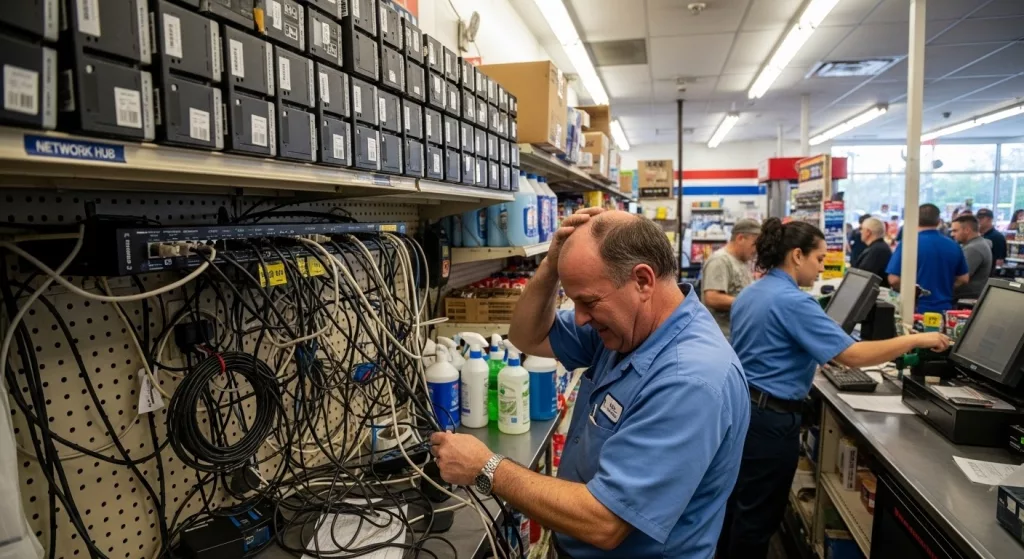
Walk into the back office of almost any mid-size c-store operation and you’ll find the same thing: a collection of solutions, each one purchased to fix a specific problem, none of them talking to each other.
There’s nothing wrong with any individual piece. Your Passport or Commander handles the forecourt. Your distributor portals process your orders. Your back office software reconciles your daily sales. Your spreadsheet tracks the rest.
Each box does its job.
The problem is the space between the boxes.
That’s where your data lives in four different formats that don’t agree with each other. That’s where your manager spends three hours every week manually moving numbers from one system to another. That’s where a variance shows up and nobody can tell you whether it came from a short shipment, a cashier problem, a fuel discrepancy, or a data entry error – because each system only saw part of what happened.
And every time a new problem surfaces, the instinct is to find another tool that solves that specific problem. Another login. Another vendor. Another monthly fee. Another export to reconcile.
The stack gets taller. The gaps get wider.
What It Actually Costs to Run Disconnected
Most operators feel the friction of disconnected systems every day – the extra steps, the manual reconciliations, the phone calls to managers asking for numbers the system should already know. What they don’t always see is the dollar figure attached to it.
Here’s where disconnected systems cost you money in ways that don’t show up as a line item:
Shrinkage you can’t isolate. When a variance appears across disconnected systems, you can’t trace it. You know something is off at store three. But is it a receiving problem? A cashier problem? A fuel variance? Without a single system that sees the full picture, you’re guessing – and undiagnosed shrinkage averages 1-3% of merchandise sales across the industry.
Rebates you’re not collecting. Scan data programs from your tobacco and beverage vendors pay real money – potentially $5,000 to $15,000 per location per year – but only if the data gets submitted accurately and on time. When that process lives in a separate portal that somebody has to remember to log into, it gets missed. Consistently.
Orders placed on instinct, not data. Logging into your distributor portals store by store, eyeballing what looks low, placing an order – that’s not inventory management, that’s guessing with extra steps. Without a system that knows your actual on-hand count and your sales velocity, you’re either over-ordering and tying up cash or under-ordering and losing sales.
Manager time spent on data, not operations. Every hour a manager spends reconciling reports from three different systems is an hour they’re not on the floor, not training staff, not catching the problems that only get caught by someone paying attention.
None of these show up on an invoice. But they’re real costs, compounding across every store, every month.
The Difference Between a Stack of Tools and an Ecosystem
Here’s the question worth asking about your current setup:
When a delivery arrives at store four, does that event automatically update your on-hand inventory, reconcile against the purchase order, flag any discrepancy, adjust your reorder point, and feed into your daily margin report – without anyone touching a keyboard?
If the answer is no – if any part of that chain requires a manual step, a separate login, or a spreadsheet – you don’t have an integrated operation. You have a collection of tools that you’re personally holding together.
That’s fine at one store. At ten stores, you’re the integration layer. And that doesn’t scale.
A true c-store operating ecosystem works differently. Your POS data, your inventory, your fuel reconciliation, your ordering, your back office reporting, and your vendor scan data all live in one place – with one data set that every part of the business reads from. No exports. No reconciliation. No “which system do I trust?”
When a cashier voids a transaction, the inventory system sees it. When a delivery comes in short, the back office sees it. When store seven’s energy drink velocity spikes on Friday afternoons, the ordering system sees it and adjusts automatically.
Everything that happens in your stores flows into one place, in real time, in a format that’s already standardized and ready to act on.
That’s not a better version of what you already have. It’s a fundamentally different way of running the operation.
Your Action for This Week: Count Your Logins
This one takes two minutes and will tell you everything about where you are operationally.
Write down every system, portal, or tool someone in your organization logs into to run your stores. Include your POS reporting, your back office, your distributor ordering portals, your scan data programs, your fuel management system, your payroll, your spreadsheets.
Count them.
Now ask: how many of those systems automatically share data with each other without a human in the middle?
That gap – between the number of systems you run and the number that actually talk to each other – is your operational overhead. It’s the manual work, the reconciliation errors, the missed rebates, and the variances you can’t explain.
It’s also the number you should walk into any technology conversation with. Not “I need a better inventory tool” – but “I need to stop running my business through twelve disconnected systems and start running it through one.”
See how Petrosoft’s integrated ecosystem connects every part of your c-store operation
One platform. One data set. Every store.