
Estimated reading time: 9 minutes
In convenience retail, the coffee bar is arguably the most underestimated piece of real estate inside your four walls. Fuel gets customers to your lot, sure, but a well-run coffee program is what separates a forgettable pit stop from someone’s actual morning routine. And that distinction is worth serious money.
According to NACS, hot dispensed beverages consistently rank among the top in-store categories for margin performance, with coffee driving a significant share of the “food service” gross profit that now accounts for roughly 37% of in-store sales industry-wide. Yet plenty of operators leave that margin sitting on the table, or more accurately, dripping down the side of an airpot no one wiped down this morning.
There is one universal truth in this business: nobody drinks coffee from a dirty station. A single dried creamer ring, a pile of used stirrers, or an empty sugar dispenser that’s been empty since 6 AM can turn a potential regular into someone who just starts going to the drive-thru down the street instead. Getting your coffee bar right isn’t complicated, but it does require intention and consistency.
Know Who’s Walking Toward That Coffee Counter
Before you think about roast profiles or condiment layouts, it helps to understand that your coffee customers aren’t a monolith. They have very different expectations, and a program that ignores that reality will always underperform.
Commuters are the backbone of any morning coffee program. They are on a strict clock, they know what they want, and any friction in the process is a dealbreaker. If they have to dig through a pile of loose lids or wait for a coworker to mop up a spill before grabbing a sleeve, they’re gone and probably posting about it. Speed and predictability are everything to this group.
Day laborers and tradespeople tend to gravitate toward large-format cups and bold, high-caffeine roasts. For them, coffee is functional fuel. Hot temperature retention matters here more than aesthetics. If the large cup lids are out or the dark roast has been sitting since 5 AM and tastes like motor oil, that sale disappears.
Long-haul truckers and road workers treat a clean, well-stocked c-store coffee bar almost like a small comfort of home. They’re in unfamiliar territory a lot of the time, and a fresh pot at 2 PM or 11 PM actually means something. NACS data shows that truck stop and travel plaza customers have among the highest average in-store transaction sizes, so losing their coffee loyalty has a real basket-size consequence.
Parents with kids in tow are a segment a lot of operators underestimate. They want customization options, syrups, dairy alternatives, maybe a flavored creamer or two but more than anything they want a clean station. A sticky counter or a trash can overflowing with used cups next to where they’re trying to doctor their coffee is an experience that sticks with people, not in a good way.
Night shift workers nurses, warehouse employees, security staff, these folks deserve the same quality experience at 3 AM that a commuter gets at 7. Getting penalized with the bottom-of-the-pot sludge just because of when they work is the kind of thing that sends people to a 24-hour fast food option instead.
Neighborhood regulars are perhaps the most valuable long-term segment. They’re not just buying coffee, they’re building a habit around your store. NRF research on customer loyalty consistently shows that convenience and perceived cleanliness are the top two factors driving repeat visits to food and beverage retail environments. These customers want a cafe-adjacent experience at a c-store price point.
The Real Cost of a Messy Station
This is where operators sometimes resist, because cleaning labor feels like a cost center. The math actually works the other way.
A disorganized or dirty coffee bar creates visible waste in real time. A customer who pumps three or four dispensers looking for one that isn’t empty doesn’t just get frustrated, they grab a fistful of napkins, make a bigger mess, and may not come back. That lost visit isn’t just a $2 coffee. According to NACS shopper data, coffee purchasers have an average basket attachment rate meaning they buy something else alongside their coffee well above the store average. When you lose the coffee visit, you often lose a breakfast sandwich, a water bottle, or a snack upsell on top of it.
There’s also a trust signal that operators don’t always consider. Customers associate the coffee bar with the kitchen. This is just how people think, it’s not entirely fair but it’s real. A grimy condiment area reads as a grimy food prep area, and that perception bleeds into roller grill and grab-and-go purchases, which are also high-margin categories. One dirty counter can quietly suppress food service sales across the board.
The fix is straightforward: a 30-minute cleaning rotation during peak hours. A quick wipe of the counter, a check on cup stock and condiment levels, a lid and sleeve restock. It takes maybe four minutes, and it protects every downstream sale that coffee customer might make.
How to Stock and Organize for Real Sales Performance
Getting the physical layout right matters more than most operators realize. Think about traffic flow, specifically, how a customer moves from walking in to walking out with a cup.
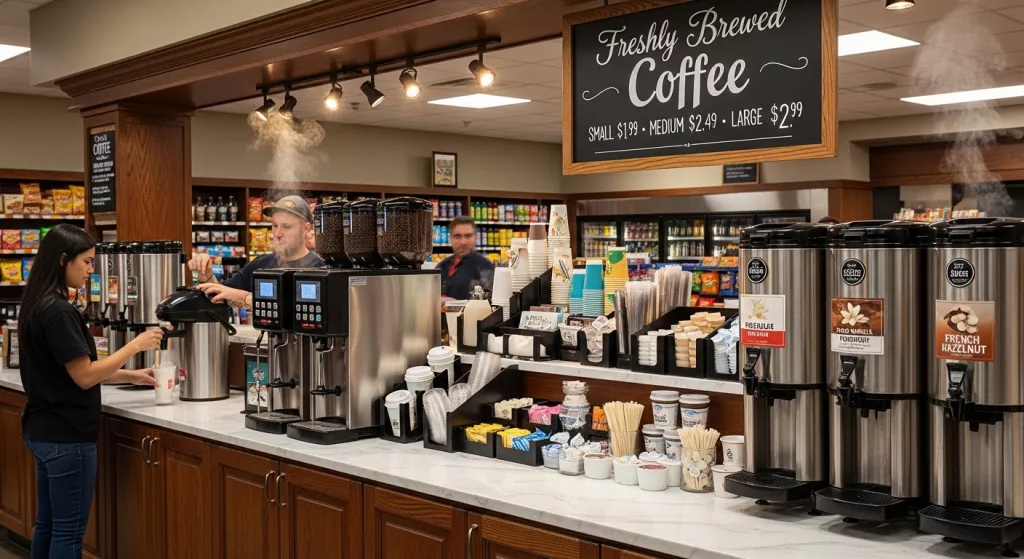
The most effective layout runs left to right: cups and lids first, then the coffee dispensers, then sweeteners and creamers, then sleeves and final lids. This mirrors the natural order of making a cup and prevents the kind of cross-traffic bottleneck that slows everything down during the 7 to 9 AM rush. Speaking of rush hours, at some point, you realize the condiment station needs its own counter space entirely separate from the cup stack, especially in higher-volume locations, but that’s a layout conversation for another time.
On roast variety, the minimum viable lineup is three profiles: light, medium, and dark. Adding one rotating seasonal or limited-time flavor gives regulars a reason to try something new and can actually drive small spikes in coffee attach rates. Pumpkin spice in September is a cliche for a reason, it works.
Temperature is non-negotiable. Coffee served below 175 degrees Fahrenheit registers as “old” to most drinkers even if it was just brewed. Use a digital thermometer to spot-check airpots during cleaning rotations. Maintaining brew temp between 175 and 185 degrees is the range where coffee tastes fresh and stays safe. Lukewarm coffee is a silent loyalty killer you might never get direct feedback on, customers just quietly stop coming.
On dairy alternatives, this is no longer optional for stores trying to compete with QSR coffee programs. Oat milk, at minimum, and a non-dairy creamer that isn’t the chalky powdered variety, should be part of the condiment lineup. The demand isn’t niche anymore.
Turning Coffee into a Loyalty Anchor
The stores that have converted their coffee bar from a commodity offering to a genuine morning-ritual destination share a few common practices beyond cleanliness and stocking.
Consistency at every hour matters. A customer who discovers your dark roast is reliably fresh at 6 AM and 6 PM will tell people. Word-of-mouth in convenience retail is still a primary discovery mechanism, especially in neighborhoods and commuter corridors where regulars talk to each other.
Loyalty integration tied directly to the coffee bar is also worth considering. NRF data consistently shows that loyalty program members spend measurably more per visit than non-members across convenience and food service categories. A simple punch card or app-based reward specifically for coffee purchases can accelerate the “pit stop to ritual” conversion significantly.
Signage at the bar itself, nothing elaborate, just clean and readable, should communicate freshness cues. “Brewed at 6:00 AM” with a visible timestamp is a low-cost trust signal that works especially well with the commuter and night-shift segments.
The Bottom Line
A clean, stocked, and thoughtfully organized coffee bar is one of the most cost-effective investments a c-store operator can make. The margin profile on hot dispensed beverages is strong, the basket attachment opportunity is real, and the loyalty potential is compounding. What undermines all of it is inconsistency, specifically, the kind of slow decay that happens when cleaning rotations slip and restocking becomes reactive instead of proactive.
The exhausted night shift nurse and the rushing hockey dad don’t have the same schedule or the same order, but they have the same expectation: a coffee bar that looks like someone actually cares about it. When that’s what they find, they come back. And they bring their whole basket with them.
FAQ: Coffee Bar Profit and Operations for C-Store Owners
How often should we actually be cleaning the coffee bar during a shift?
During peak morning hours, every 30 minutes is the practical standard. Off-peak, a 60-minute rotation is typically sufficient. The key is making it a logged task on a checklist rather than something done “when it looks bad.” By the time it looks bad, you’ve already lost customers.
What’s the minimum roast variety we should offer to be competitive?
Three roasts, light, medium, and dark, covers the majority of your customer base. A fourth option, whether seasonal, flavored, or a bold specialty blend, gives you a point of differentiation from the basic QSR coffee programs in your area.
Are dairy alternatives like oat milk actually worth the cost?
Yes, the demand has moved well past niche status. Oat milk in particular has strong adoption across multiple customer demographics. The shelf life on commercial oat milk creamers is manageable, and the per-serving cost is offset by the incremental customer you would otherwise lose to a coffee shop.
How do we handle overnight freshness without wasting product?
Brew-to-demand during late-night hours is more cost-effective than keeping full airpots running. A smaller batch with a clearly posted brew time, combined with a “fresh brewed on request” sign, actually builds trust with night shift customers rather than losing them.
Does the coffee bar really affect how customers perceive our food service items?
Yes, and this is something a lot of operators underestimate. Customers cognitively connect the coffee bar to back-of-house cleanliness standards. A dirty condiment station creates doubt about roller grill and grab-and-go food items. Keeping the coffee area clean is essentially free marketing for your entire food service program.
What’s the ROI argument for spending on better coffee equipment?
The NACS margin data on hot dispensed beverages makes this a relatively straightforward calculation. If your current equipment is producing inconsistent temperature or allowing coffee to age past a quality threshold, the lost repeat visits cost more over a quarter than better equipment would. Start with temperature monitoring as a low-cost first step before committing to full equipment upgrades.
Should we integrate coffee into our loyalty program specifically?
Strongly consider it. Coffee is a daily habit purchase, which makes it ideal for loyalty mechanics. Even a simple “tenth cup free” structure drives measurably higher visit frequency, and those incremental visits almost always include attach items that boost the average ticket.