
Estimated reading time: 7 minutes
For many gas station and convenience store owners, the fuel pumps are the main attraction. But here’s what veteran operators have known for years: gas gets customers on your lot, and the store is where you actually make money. Fuel margins are notoriously thin, sometimes just a few cents per gallon, and with operating costs climbing year over year, leaning on pump revenue alone is a losing strategy.
According to NACS, in-store sales account for roughly 34% of total c-store revenues but generate the vast majority of gross profit dollars. If you want a sustainable, growing business, the investment of your time and attention needs to be inside those four walls.
The Highest-Margin Categories to Focus On
Not all products are created equal. Gross profit margin — what you sell something for minus your cost of goods — is the number that matters. High sales volume with thin margins does far less work for you than a well-positioned product with a 55% margin. Here’s where the real money lives.
Prepared Food and Foodservice consistently leads the industry with margins ranging from 50% to over 60%. Customers today want real, hot food and they want it fast. A roller grill is one of the highest-return investments in the business — hot dogs, taquitos, and egg rolls require minimal labor and practically sell themselves. Breakfast sandwiches and burritos dominate the morning rush and, more importantly, build daily habits that bring customers back tomorrow. As your program grows, pizza by the slice or fried chicken can turn your store into a legitimate food destination. Food quality and food safety are non-negotiable here — one bad experience unravels months of effort.
Hot Dispensed Beverages, especially coffee, might be the single best product in the channel. Margins routinely exceed 60%, and customers who build a coffee habit at your location are among your most valuable repeat visitors. Consistency and cleanliness matter more than complexity. A well-maintained station with fresh beans and a clean condiment area will outperform a neglected premium machine every time.
Fountain and Frozen Beverages offer similarly strong margins in the 50-60% range. The syrup-to-water economics on a large fountain drink are remarkable, and frozen beverages drive meaningful incremental sales with younger demographics and during warmer months. Placement and clear cup sizing at the station are low-cost ways to increase upsizing and ticket averages.
Packaged Beverages carry lower margins (typically 30-40%) but the volume and customer demand are undeniable. Energy drinks in particular have become one of the most dynamic categories in the store, with premium brands commanding $4-5 per can and strong dollar margin per unit even at modest percentages. Keep your cooler organized, well-lit, and zoned by category — a disorganized cooler door loses sales before they start.
Candy and Packaged Snacks are where impulse purchasing lives. Margins run 40-50% and placement does most of the selling. Nuts and seeds tend to carry higher margins than chips, so give them prominent positioning. The better-for-you snack segment, protein bars, meat snacks, and low-sugar options, has grown significantly. NRF research has tracked a consistent shift toward functional snacking among millennial and Gen Z shoppers, and ignoring that trend means leaving a growing customer segment underserved.
Inventory Management That Protects Your Margin
Knowing what to sell is only half the job. Inventory management is where a lot of operators leave serious profit on the floor.
Your POS system is your inventory brain. Petrosoft’s CStoreOffice back-office platform integrates directly with your point-of-sale to give real-time stock tracking, automated reorder alerts, and detailed category-level reporting from a single dashboard. Every scan at the register adjusts your inventory count automatically. The reporting capability is where most operators underutilize their systems — pull sales data by item, by time of day, and by day of week. That data tells you which products are actually working and which ones are taking up shelf space without earning it. Petrosoft’s reporting tools make it straightforward to identify slow movers, track shrink by category, and set par levels that trigger reorder suggestions before shelves run empty.
FIFO — First In, First Out — requires consistent discipline. When new product arrives, it goes to the back. Older product comes forward. This applies to every refrigerated item and especially every foodservice product. Expired product reaching a customer is a complaint, a potential safety issue, and a reason they never return. Walk your coolers daily.
Cycle counts catch problems before they compound. High-value categories like tobacco and phone accessories should be counted frequently, not just at quarterly audits. Petrosoft’s back-office tools support cycle count workflows that help operators catch theft, receiving errors, and spoilage on a rolling basis. NACS data shows convenience stores lose billions annually to shrink across the channel — regular cycle counts are one of the most direct ways to protect your margins.
Turning Traffic into Profit
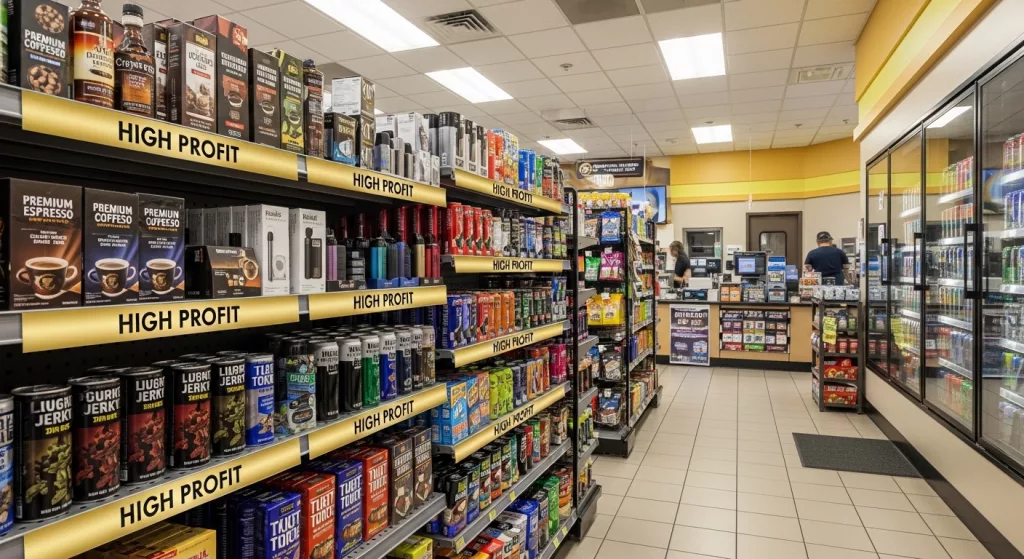
Merchandising drives margin. Eye level is buy level — your highest-margin items belong in prime visual real estate, not the bottom shelf. The checkout zone is some of the most valuable space in your store. Gum, mints, single-serve candy, lighters, and phone chargers placed near the register capture impulse purchases that a customer didn’t plan on making when they walked in. Cross-merchandising — salty snacks near the beer cooler, cookies next to the coffee station — consistently lifts basket size without any additional marketing spend.
Convert pump traffic to in-store sales. Someone standing at your pump for three to five minutes is a captive audience. Pump toppers, screen ads on modern dispensers, and simple signage promoting your coffee or a bundle deal drive meaningful in-store conversion. The message doesn’t need to be complicated. It needs to be visible and relevant.
Loyalty programs are proven revenue drivers. NACS has reported that loyalty members spend more per visit and visit more frequently than non-members. Petrosoft integrates loyalty program functionality through its platform, giving operators the ability to track customer behavior, run targeted promotions, and reward repeat visits — all from the same system managing your inventory and reporting. The data collected through a loyalty program turns guesswork into precision marketing.
Cleanliness and customer service are not optional. Dirty restrooms are a primary reason customers stop choosing a location. Clean, well-stocked restrooms, bright lighting, organized shelves, and a staff that greets customers — these things create an experience worth repeating. Train employees to suggest add-ons and keep the store maintained through every shift.
Conclusion
Fuel will always get customers onto your lot. But the profit is inside the store. Prepared food, dispensed beverages, packaged snacks, and packaged drinks are the categories that build real gross profit. A modern back-office system like Petrosoft’s CStoreOffice, disciplined inventory practices, and smart merchandising are what protect and grow it. The math is clear, and the margin is waiting.
Frequently Asked Questions
What is typically the highest-margin product category in a convenience store?
Prepared food and foodservice leads the pack with gross margins from 50% to over 60%. Hot dispensed beverages, particularly coffee, are right alongside it. Both require operational attention, but the return is hard to match with packaged goods alone.
How do I know which products in my store are actually making me money?
Your POS and back-office reporting are the starting point. Look at gross profit dollars by category and by SKU, not just sales volume. Petrosoft’s CStoreOffice surfaces this data automatically, so operators can see exactly which products and categories are earning their shelf space.
How often should I be doing inventory counts?
A full physical count should happen at least quarterly. For high-value or high-shrink categories like tobacco and phone accessories, do partial cycle counts weekly or biweekly. Catching discrepancies early prevents small problems from becoming significant losses.
My fuel customers rarely come inside. How do I change that?
Start at the pump with signage promoting specific in-store items — coffee, a food deal, clean restrooms. Tie in-store promotions to fuel purchases, like a discount on coffee with a fill-up. Loyalty programs delivered through mobile can also reach customers while they’re already on your lot and prompt an in-store visit.
Do loyalty programs actually work for independent c-store operators?
They do. The core mechanics — rewarding repeat visits, offering personalized deals, collecting purchase data — don’t require a massive technology budget. Petrosoft’s platform includes loyalty integration designed for the c-store channel, giving independent operators access to the same tools the big chains use without the enterprise price tag.
What should I focus on first to improve in-store profitability quickly?
Coffee and dispensed beverages are usually the fastest path to improved margins because product cost is low and customers are already looking for them. Pair that with a review of your checkout zone merchandising and your back-office reporting setup to make sure shrink is visible and reorder levels are accurate. Those three moves alone can show measurable results within a few weeks.